Innovating for a sustainable future
Re-making industrial products to protect our planet through low carbon footprint solutions
Modified biochar for industries that need to decarbonize. From the carbon market to the construction site, gas and liquid filtration, and the production line. We sell biochar as a product, not as a credit.


A carbon-negative drop-in filler for gypsum wallboard. We replace a portion of the gypsum mass with modified biochar, turning every sheet of wallboard into a long-duration carbon sink without changing the manufacturing line or the finished product's performance. At loadings of 5–15% by mass, our formulations preserve the mechanical envelope that buyers spec against — hardness, nail-pull resistance, flexural strength comparable to commercial 5/8″ Type X benchmarks — while cutting embodied carbon by up to a third. The market that wants this material first is hyperscale data centers, global hotel chains, and Scope-3-disclosed corporates: operators with embodied-carbon mandates moving upstream into the materials they specify. Our work on biochar–gypsum slurry rheology and biochar-modified gypsum crystal networks is grounded in peer-reviewed science and supported by EPA SBIR funding. No consumer literacy is needed: the substitution happens inside the existing wallboard supply chain.

A biochar masterbatch that replaces fossil-derived carbon black with a carbon-negative, dual-function additive — pigment and filler in the same compound. BMB plugs into existing twin-screw extrusion lines: no retooling, no re-training, no downstream re-spec. Third-party validation work in HDPE shows that at 1% biochar loading the opacity matches conventional carbon black at 0.1%, with yield strength, modulus, and elongation indistinguishable from neat HDPE. Twin-screw extrusion converts mm-range biochar feed into μm-range dispersion in-line, so the customer's existing compounding equipment does the work. Two commercial pathways: in injection-molded pieces at 20% loading, BMB sells near raw polypropylene with a 20% embodied-carbon reduction; in dry-blended HDPE pipe extrusion at 20% loading, the math flips to a 12% material cost reduction and a 27% carbon reduction. The decarbonization sits upstream of the brand owner, where Scope-3 reporting is forcing change anyway. Our peer-reviewed work on biochar feedstock, particle size, and polymer matrices anchors the formulations, you can see them here. We are engaged with national and regional plastics distributors.
Modified biochar cartridges that drop into existing filter housings, replacing the activated carbon, iron sponge, and biological-scrubber media that homes and anaerobic digester operators consume on weekly-to-monthly cycles. Biochar's pore network (140–320 m²/g BET surface area on raw pine-sawdust feedstock, tunable upward with our surface modification) makes it natively suited to capturing hydrogen sulfide — the corrosion, OSHA, and renewable-natural-gas-purity problem every digester operator already pays to solve.





Our team is made of world experts on biochar applications. The years and experience in the biochar application R&D space can be found here
Our technical multidisciplinary background is grounded in sustainability. We know what it takes to be sustainable, it is not a buzzword.
Here you will find some peer reviewed publications through our partnership with world class universities
Our CEO Thomas Trabold talked about biochar stability and versatility in this Salon article! Check it out! https://lnkd.in/dMT8TXTt
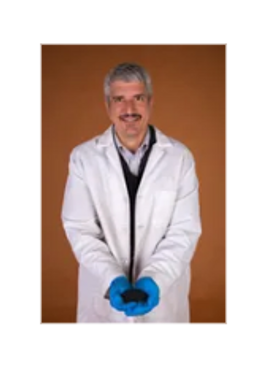
Our CEO Thomas Trabold at Rochester Institute of Technology
Check it out!:
https://www.rit.edu/news/innovative-solutions-take-bite-out-food-waste